100 Days of CUDA
My Notes and codes documentation for CUDA learning journey
Summary of Day 61:
So, today I fixed yesterday’s MHA triton implementation. Took a lot of time so not going into CUDA today. However, will explain the code mechanism in very minute detail so that everyone could understand. Also, this would be a revision for me.
Understanding the $Q, K, V$ kernel:
Firsty, let’s understand the parameters defined in this kernel.
def qkv_kernel(
    input_ptr,
    wq_ptr, wk_ptr, wv_ptr,
    bq_ptr, bk_ptr, bv_ptr,
    q_ptr, k_ptr, v_ptr,
    batch_size: tl.constexpr, seq_len: tl.constexpr, embed_dim: tl.constexpr,
    head_dim: tl.constexpr, num_heads: tl.constexpr, stride_batch: tl.constexpr,
    stride_seq: tl.constexpr, stride_head: tl.constexpr
):
So, here:
input_ptr: Pointer to the input tensor; shape of[batch_size, seq_len, embed_dim].wq_ptr,wk_ptr,wv_ptr: Pointer to the weights matrics for query, weight and vector. Shape of[num_heads * head_dim, embed_dim].bq_ptr,bk_ptr,bv_ptr: Pointer to the bias matrics for query, weight and vector. Shape of[num_heads * head_dim].q_ptr,k_ptr,v_ptr: Pointers to the output tensors. Shape of[batch_size, num_heads, seq_len, head_dim].batch_size: Number of samples in a batch. Defines how many independent inputs are processed in parallel. Used to ensure thebatch_idxdoes not exceed valid range.seq_len: Length of the sequence (number of tokens). Specifies how many positions in the sequence need $Q, K, V$ projections.embed_dim: Dimension of input embeddingshead_dim: Dimensionality of each attention heads (embed_dim // num_heads)num_heads: Number of attention heads in MHAstride_batch: The memory stride between consequtive batches. Multiplied withbatch_idxto compute the base offset of a batchstride_seq: The memory stride between consequtive sequences. Multiplied withseq_idxto compute offset for a specific position.stride_head: The memory stride between consequtive heads. Multiplied withhead_idxto access the data for a specific head.
Now explaining the inner mechanism:
-
First comes thread indexing and bounds checking. The kernel is launched with a 3D grid size of (
batch_size, seq_len, num_heads). - Next, memory offset calculation:
- The
input_offsetis quite simple. It points to the start of the input vector for the current batch and sequence position. - In
qkv_offset, we even account for the heads, hence adding the heads offset. (as $Q, K, V$ are split across heads)
- The
- Now comes projection loop:
- The outer loop: (d loop)
- Iterates over the output dimension (
head_dim), computing one element of $Q, K \text{ and } V$. Since each element needs a full dot product.
- Iterates over the output dimension (
- The inner loop: (e loop)
- Iterates over the input dimension (
embed_dim), performing the dot product.
- Iterates over the input dimension (
- The outer loop: (d loop)
[!Note] Does the dot product by multiplying and summing accross the input vector and one row of the weight matrix.
[!important] How this whole thing works:
- The Outer loop’s setup:
acc_q, acc_k, acc_vare accumulators (like temporary variables) initialized with bias values.- Bias is fetched from memory:
bq_ptr + head_idx * head_dim + dpicks the bias for this head and this output element.- Think of
das the “index” of the output vector we’re filling.- The Inner Loop:
- Loads one input element:
x_val = tl.load(input_ptr + input_offset + e).- Loads one weight from each matrix:
wq_valfrom $WQ$ at row (head_idx * head_dim + d), columne.wk_valfrom $WK$, same row and column.wv_valfrom $WV$, same row and column.- Multiplies and adds to accumulators:
acc_q += x_val * wq_val(Query dot product).acc_k += x_val * wk_val(Key dot product).acc_v += x_val * wv_val(Value dot product).
[!note] For one output element
(d), we multiply the entire input vector by one row of the weight matrix and sum the results.
The attention_kernel:
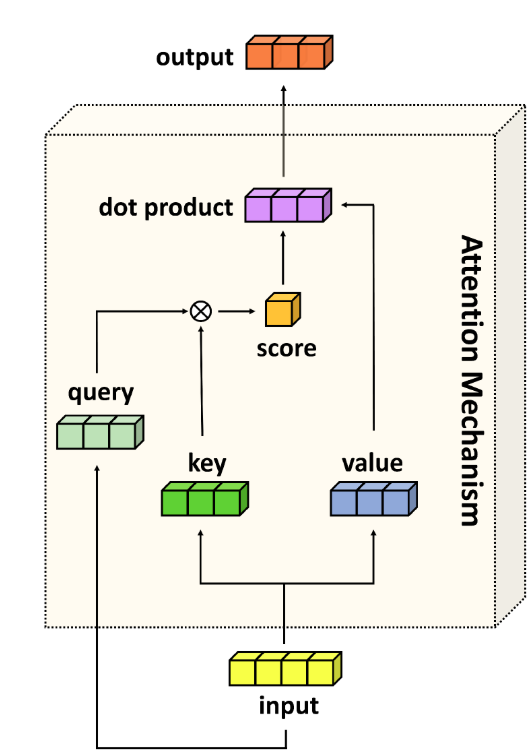
Fig 61_01: Attention Mechanism
Params recap:
- Pointers:
q_ptr, k_ptr, v_ptr(inputs),scores_ptr(intermediate scores),output_ptr(final output). - Dimensions:
batch_size, seq_len, head_dim, num_headsdefine the tensor shapes. - Strides:
stride_batch, stride_seq, stride_headnavigate memory. - Scale:
scale = 1/sqrt(head_dim)normalizes the dot product.
Thread initalization and boundary check:
- similar to above.
Memory Offsets:
q_offset = batch_idx * stride_batch + seq_idx * stride_seq + head_idx * stride_head- Points to the start of the Query $(Q)$ vector for this thread’s (
batch_idx, seq_idx, head_idx) in the $Q$ tensor. - Shape of $Q$:
[batch_size, seq_len, num_heads, head_dim]- $4D \text{ tensor.}$
- Points to the start of the Query $(Q)$ vector for this thread’s (
scores_offset = batch_idx * seq_len * num_heads * seq_len + seq_idx * num_heads * seq_len + head_idx * seq_len- Shape of
scores:[batch_size, seq_len, num_heads, seq_len]
- Shape of
[!important]
- The
batch_idx * seq_len * num_heads * seq_lenshifts the offset for the batch. Here we account for all the attention socres in previous batches, each of which hasseq_len * num_heads * seq_lenscores.seq_idx * num_heads * seq_lenmoves to the correct query position in the sequence. Each query position hasnum_heads * seq_lenscores (because each head generates a score for each key position).head_idx * seq_lenmoves to the correct attention head for a given query.
[!Caution] The order of multiplication matters!!
Explaining this with an example:
seq_len * num_heads * seq_len: This keeps the memory layout in a format that:
- first: traverses all sequence lengths (for queries),
- then iterates over all heads,
- and finally over the keys.
This is how it’s structured to take advantage of memory access patterns when we’re iterating over the tensor.
- If we change this to
num_heads * seq_len * seq_len:
- This would change the memory access pattern. With this order, you’d:
- First iterate over heads,
- then over query positions,
- and lastly over key positions.
This could work too, but it would lead to a different way of accessing memory, which might not be as efficient in certain cases, especially in terms of how the data is loaded into cache.
[!tip]
- Use
seq_len * num_heads * seq_lenfor storing attention scores!✅ Why?
- Keeps all values for a single query together → faster softmax & attention
- Better GPU memory coalescing → fewer trips, less latency
Avoids cache misses → speeds up computation
❌ Avoid
num_heads * seq_len * seq_len→ Scatters data, slows down memory access!- Rule of Thumb: Always structure memory for contiguous access!
Computing Attention Scores:
\[\text{Attention}(Q, K, V) = \text{softmax}\left(\frac{QK^T}{\sqrt{d}}\right)V\]- So, next we calulate the
Q * K^T:- Here we have not explicitly used any transpose operation. Instead, we are defining the offset values of $Q$ and $K$ such that there is no need to physically transpose $K$.
[!important] The
q_offsetis calculated as:
q_offset = batch_idx * stride_batch + seq_idx * stride_seq + head_idx * stride_headThis means for each query, we’re accessing the query vector for a specific batch, sequence position and batch index.
The
k_offsetchanges slightly:
k_offset = batch_idx * stride_batch + k_seq * stride_seq + head_idx * stride_headThe crucial change here is that instead of using
seq_idx(the query sequence index) as inq_offset, we’re usingk_seq(the loop variable) to access the key vector at each position in the sequence. This allows us to access all of the keys for a given query sequence position.Why this works:
- By modifying the offset for $K$, we allow the query vector at a given position to “align” with each key vector from the sequence (looping through k_seq).
- This results in a dot product that’s essentially the same as multiplying $Q$ with $K^T$.
Softmax Calculation:
Next, we have softmax calculation:
\[\text{Softmax}(X_i) = \frac{e^{x_i}}{\sum_{j=1}^{n} e^{x_j}}\]- First we find the max score for numerical stability.
- We initialize the
max_scoreto negative infinity. - Then we iterate over all sequence positions (
k_seq), loading the score values.
- We initialize the
-
Numerical instability could be caused by large exponentiated values.
- Then, the sum calculation part:
- We subtract
max_scorefrom each score before exponentiating (to prevent the overflow). - Then we store the exponentiated values in
scores_base. - And then we accumulate.
- We subtract
- Next we divide; hence getting the activation function.
And that’s how the kernel works.
[!Note] Explaining the wrapper function
- We start with
scale = 1.0 / math.sqrt(head_dim)to normalize attention scores later. Sincehead_dimisembed_dim // num_heads, we take the square root to scale down dot products inQ * K^T, preventing them from growing too large and destabilizing the softmax in theattention_kernel. For example, ifhead_dim=4,scale=0.5.- Next, we grab weights and biases from
attention_layer(a PyTorchMultiheadAttentionobject). Itsin_proj_weightis a big tensor[3*embed_dim, embed_dim]—three stacked weight matrices for Query (Q), Key (K), and Value (V).- We slice
wq = attention_layer.in_proj_weight[:embed_dim].Tto get the Query weights, the firstembed_dimrows. We transpose it (.T) from[embed_dim, embed_dim]to[embed_dim, embed_dim]because Triton kernels expect weights in[out_dim, in_dim]format, unlike PyTorch’s default. This projects input to Q.- We do the same for
wk = attention_layer.in_proj_weight[embed_dim:2*embed_dim].T(Key weights) andwv = attention_layer.in_proj_weight[2*embed_dim:].T(Value weights), slicing the next chunks and transposing them. Each is[embed_dim, embed_dim], tailored for K and V projections.- For biases, we check
in_proj_bias(size3*embed_dimor None). If it exists, we slicebq = attention_layer.in_proj_bias[:embed_dim]for Query,bk = attention_layer.in_proj_bias[embed_dim:2*embed_dim]for Key, andbv = attention_layer.in_proj_bias[2*embed_dim:]for Value—eachembed_dim-sized. If None, we usetorch.zeros(embed_dim, device=DEVICE)to create zero tensors on the GPU (CUDA), ensuring no bias offset when the layer skips it.- We grab
wo = attention_layer.out_proj.weight([embed_dim, embed_dim]) andbo = attention_layer.out_proj.bias([embed_dim]or None, defaulting totorch.zeros) for the final output projection. No transpose here—PyTorch’slinearexpects[out_dim, in_dim], which matcheswo.- We allocate output tensors on the GPU with
torch.empty:q,k,vas[batch_size, seq_len, num_heads, head_dim]for Q, K, V projections. These are initially uninitialized (faster than zeros) sinceqkv_kernelfills them.- We set
scores = torch.zeros(batch_size, seq_len, num_heads, seq_len, device=DEVICE, dtype=torch.float32)as a 4D tensor for attention scores. We use zeros to initialize it cleanly—attention_kerneloverwrites it with raw scores, then softmax weights.- We also allocate
output = torch.empty(batch_size, seq_len, num_heads, head_dim, device=DEVICE)for the attention result, uninitialized sinceattention_kernelpopulates it.- We define a 3D grid
grid_qkv = (batch_size, seq_len, num_heads)and launchqkv_kernelwith it. This grid means one thread per(batch, seq, head)combo—e.g., for[2, 8, 4], that’s 64 threads. We passinput_tensor, weights (wq,wk,wv), biases (bq,bk,bv), output tensors (q,k,v), and shape/strides. It computes Q, K, V in parallel.- We reuse the same grid
grid_attn = (batch_size, seq_len, num_heads)forattention_kernel. We passq,k,v,scores,output, shape/strides, andscale. This computes attention:softmax(Q * K^T * scale) * V, fillingoutput.- We reshape
outputfrom[batch_size, seq_len, num_heads, head_dim]to[batch_size * seq_len, embed_dim](e.g.,[2, 8, 4, 4]→[16, 16]) by flattening the head dimension. This concatenates head outputs, mimicking transformer behavior.- We apply
torch.nn.functional.linear(output, wo, bo)—a matrix multiplication withwoand bias addition withbo—to project the concatenated result back toembed_dim. This gives us[batch_size * seq_len, embed_dim].- We reshape again to
[batch_size, seq_len, embed_dim](e.g.,[2, 8, 16]) to match the input shape, making it usable in a PyTorch pipeline.- Finally, we return this tensor—the multi-head attention output, ready for downstream layers.