100 Days of CUDA
My Notes and codes documentation for CUDA learning journey
Summary of Day 06:
*Continuation of chapter 4:
Warps and SIMD Hardware:
- About Warps : In CUDA, when a block of threads is assigned to a SM, its further divided into smaller units called as warps.
- A warp typically consists of 32 threads that are scheduled and executed together.
- Let’s think of it as a team of 32 workers who receive the same instruction but work on different pieces of data. And the concept of same instruction but different data points is the concept of SIMD Hardware.
- About SIMD : One Instruction is executed simultaneously across multiple data points.
- Single Instruction, Multiple Data
- This model helps GPUs achieve high efficiency because it reduces the overhead of managing different instructions for different threads.
Further in depth summary:
- In the start of the subsection, authors have talked about the Blocks and Threads Execution:
- Blocks execute in any order relative to each other for scalability.
- Inside a block, threads can also execute in any order unless we use the barrier synchronization to ensure certain phases are completed.
- Warps Formation:
- When a block is assigned to a SM, it is split into the warps of 32 threads
⚠️ As said earlier it’s standard to have 32 threads
- Example: For a block of 256 threads;
\text{Number of warps} = \frac{256}{32} = 8 \space \text{warps}and, if there are like 3 blocks in the SM;
\text{Total warps} = 8 \times 3 = 24 \space \text{warps in total}
- When a block is assigned to a SM, it is split into the warps of 32 threads
- Warp Partitioning Based on Thread Indices:
- For 1-D block, threads are partitioned straightforward way:
- Warp 0 = Threads (0 to 31),
- Warp 1 = Threads (32 to 63) and so on…
What I’m trying to say here is that: okay let’s say we have like block of 48 threads. Then, the very first warp would have threads from 0 to 31 (32 in total) and remaining $48 - 32 = 16$ on warp 1.
- For 1-D block, threads are partitioned straightforward way:
- For Multi_dimensions:
-
For 2-D and 3-D blocks, threads are “linearized” in row-major order (like 2D arrays).
-
In 2-D block, all threads with the same
threadIdx.yare grouped together; sorted bythreadIdx.x. -
In 3-D, all threads with
threadIdx.z = 0are placed first, followed by those withthreadIdx.z = 1and so on…
-
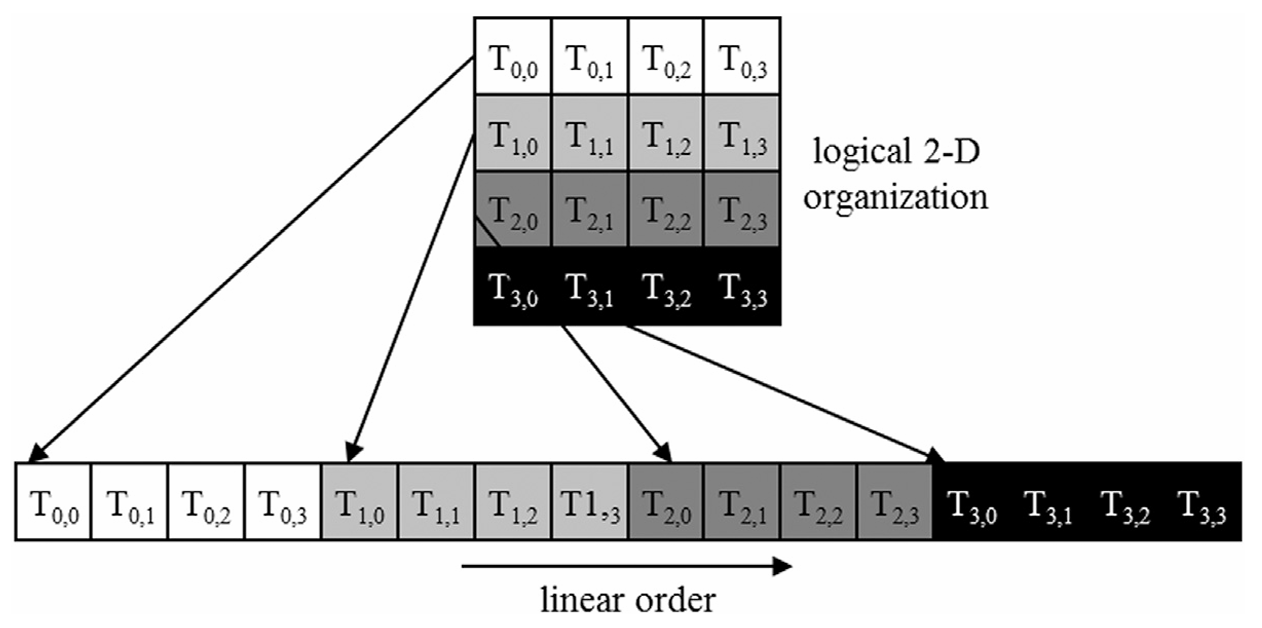
Fig: 6_01: Placing the 2D blocks to linear layout
- SIMD: — Explained Above (☝️)
The advantage of SIMD is that the cost of the control hardware, such as the instruction fetch/dispatch unit, is shared across many execution units. This design choice allows for a smaller percentage of the hardware to be dedicated to control ___
Warps and SIMD Hardware:
Okay, so the “Von Newmann Model”; which we studied on Microprocessors Subject (only relatable to CS studs), is the core model that fuels up the Warps and SIMD hardware design.
For those outside this circle, Von Newmann Model is the foundation of how traditional computers work. Its based on stored program computers where the program data and instruction data are stored in the same memory.
In this model,
- Programs and data are both stored *in memory.
- The Control Unit (CU) fetches an instruction from memory, decodes it, and then executes it.
- There’s a Program Counter (PC) that keeps track of which instruction comes next.
- The process is simple:
graph LR;
  A[Fetch] --> B[Decode]
  B --> C[Execute]
  C --> D[Repeat]
  D --> A
Below is the diagram for Von-Newmann Architecture:
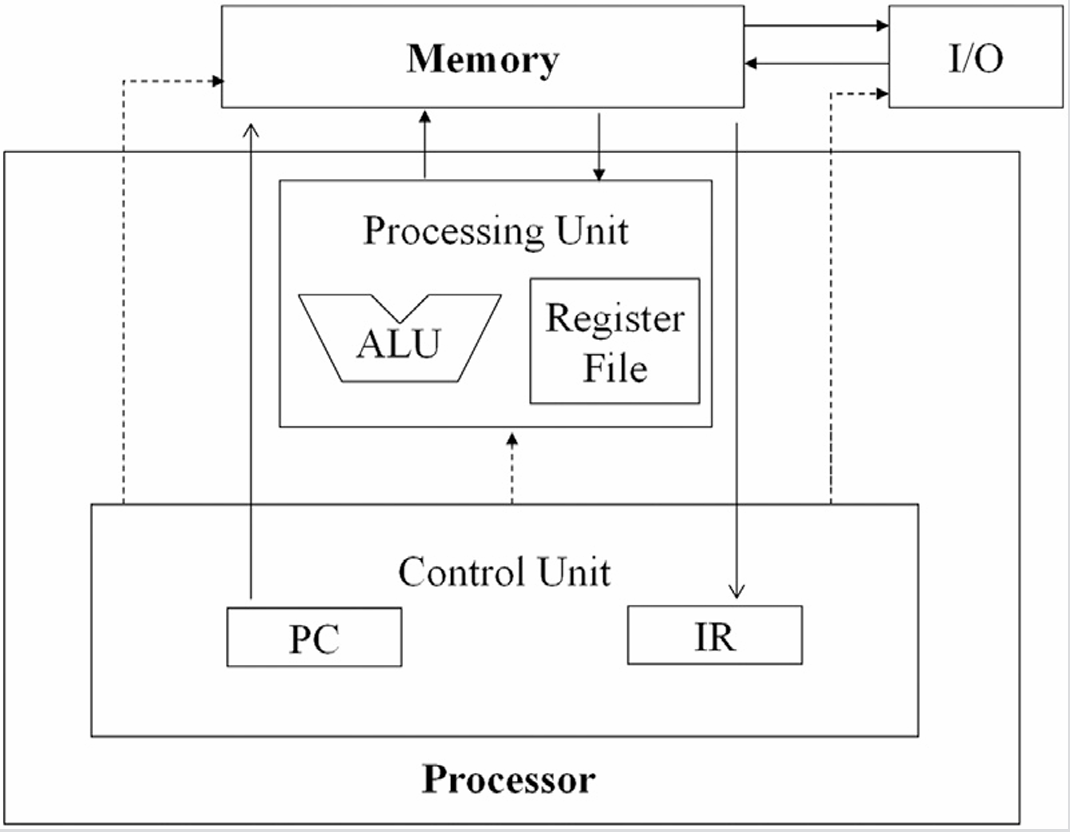
Fig: 6_02: The Von-NewMann Architecture
How Is GPU Architecture Different?
GPUs follow a modified version of the Von Neumann Model, but with one big change—“parallelism”.
Instead of processing one instruction at a time like CPUs, GPUs are designed to handle thousands of operations simultaneously. Here’s how:
-
Single Control Unit, Many Cores:
- A single Control Unit fetches an instruction just like in Von Neumann, but instead of sending it to one processor, it sends the same instruction to many processing cores at once.
- Think of it like a teacher (Control Unit) giving the same assignment (instruction) to an entire class (cores) instead of just one student.
-
Warps and SIMD Execution:
- These cores are grouped into units called warps (usually 32 threads per warp).
- All threads in a warp execute the same instruction but on different data—this is called SIMD (Single Instruction, Multiple Data).
- Example: If the instruction is to add two numbers, all threads will perform an addition, but each thread will add different pairs of numbers.
-
Why This Design Is Efficient:
- Less Hardware Overhead: Since all cores share the same Control Unit, we save on hardware costs and reduce power consumption.
- Massive Parallelism: GPUs can handle thousands of threads at once, making them perfect for tasks like image processing, scientific simulations, and machine learning.
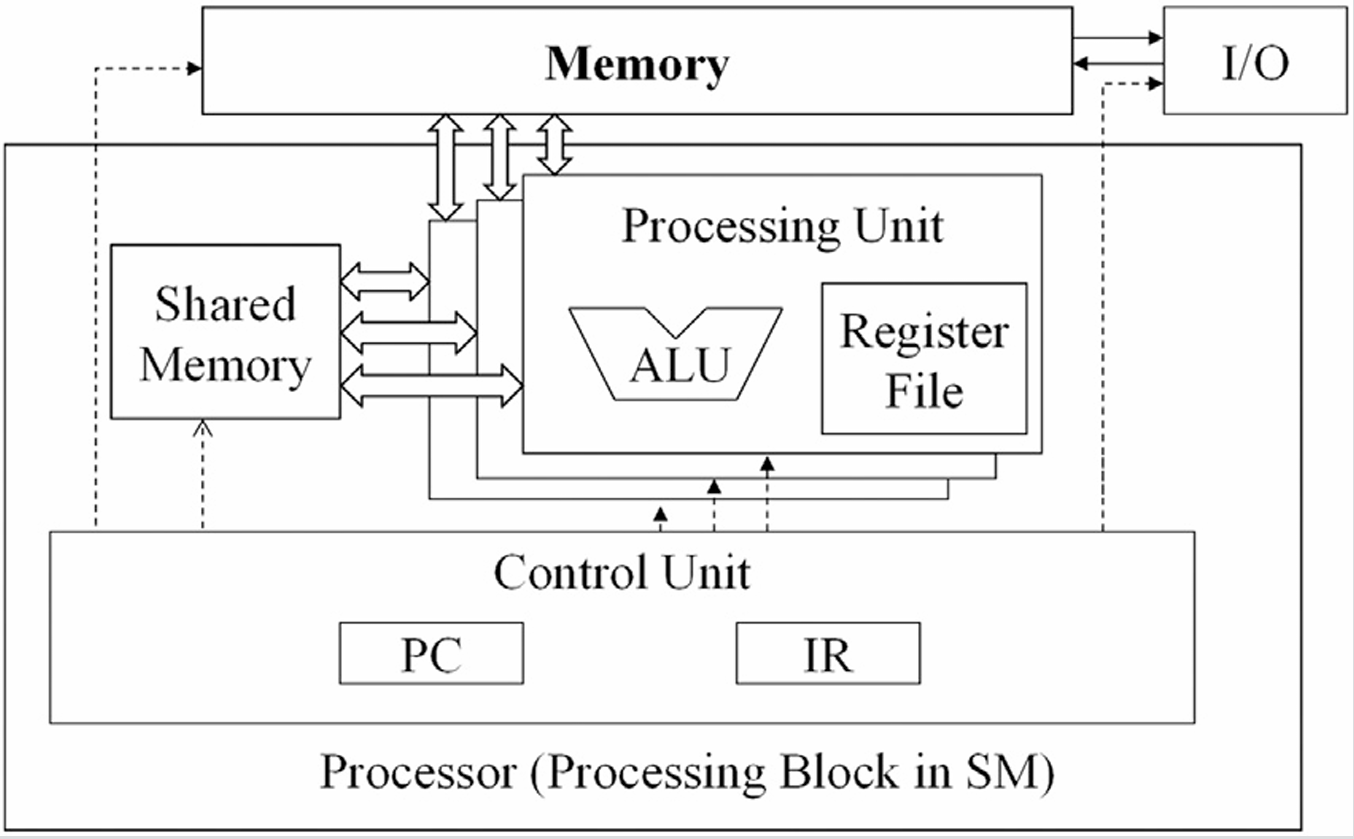
Fig: 6_02: The Modified Von-NewMann Architecture
Control Divergence
- What is it?
- Well, it occours when threads within the same warp follow different execution paths due to conditional statements (like if-else or loops)
- How GPU handles this?
- Using SIMD execution. When divergence occours:
- The hardware makes multiple passes— *one pass for each divergent path.
- During each pass, only the threads that follow the current path are active; others are inactive (idle).
-
After completing all paths, threads reconverge to continue executing common instructions.
- Using SIMD execution. When divergence occours: